How disorders of the brain, spinal cord and nervous system can affect bladder function
Frequent urination, involuntary urine leakage or difficulty emptying your bladder? The cause is not always found in the bladder or prostate. Sometimes, an underlying neurological disorder is responsible.
Our bladder does not function independently of the nervous system. Its activity depends on complex communication between the brain, spinal cord, peripheral nerves, bladder muscle and urinary sphincter.
Conditions such as multiple sclerosis, Parkinson's disease, diabetes mellitus or spinal cord injuries can interfere with this communication – sometimes long before the connection is recognised.
The medical specialty concerned with these disorders is called neuro-urology.
How does the brain control the bladder?
The urinary bladder has two essential functions: storing urine at a low pressure and emptying it completely at the appropriate time.
As the bladder fills, specialised nerves transmit information about its filling level to the spinal cord and brain.
The brain determines when it is appropriate to urinate. Until then, the bladder muscle remains relaxed while the urinary sphincter stays closed.
During urination, the opposite occurs: the sphincter relaxes and the bladder muscle contracts.
This process is coordinated by various centres in the brain, particularly the brainstem, and by nerve pathways within the spinal cord.
If this communication is disrupted, the bladder may become overactive, lose its ability to contract effectively or attempt to empty against a closed sphincter.
The consequences range from bothersome urinary urgency to severe bladder dysfunction that may threaten kidney health.
Which symptoms may indicate a neurological bladder disorder?
Symptoms vary depending on which part of the nervous system is affected.
Possible signs include:
- Sudden, difficult-to-control urinary urgency
- Frequent urination, including at night
- Involuntary urine leakage
- Weak or intermittent urinary stream
- Difficulty initiating urination
- A sensation of incomplete bladder emptying
- Reduced or absent sensation of bladder filling
- Recurrent urinary tract infections
Not every one of these symptoms indicates a neurological disorder. However, when urinary symptoms occur alongside a known neurological condition or cannot be explained by routine urological investigations, further assessment may be appropriate.
Why the level of a spinal cord injury matters
One of the most important principles of neuro-urology is:
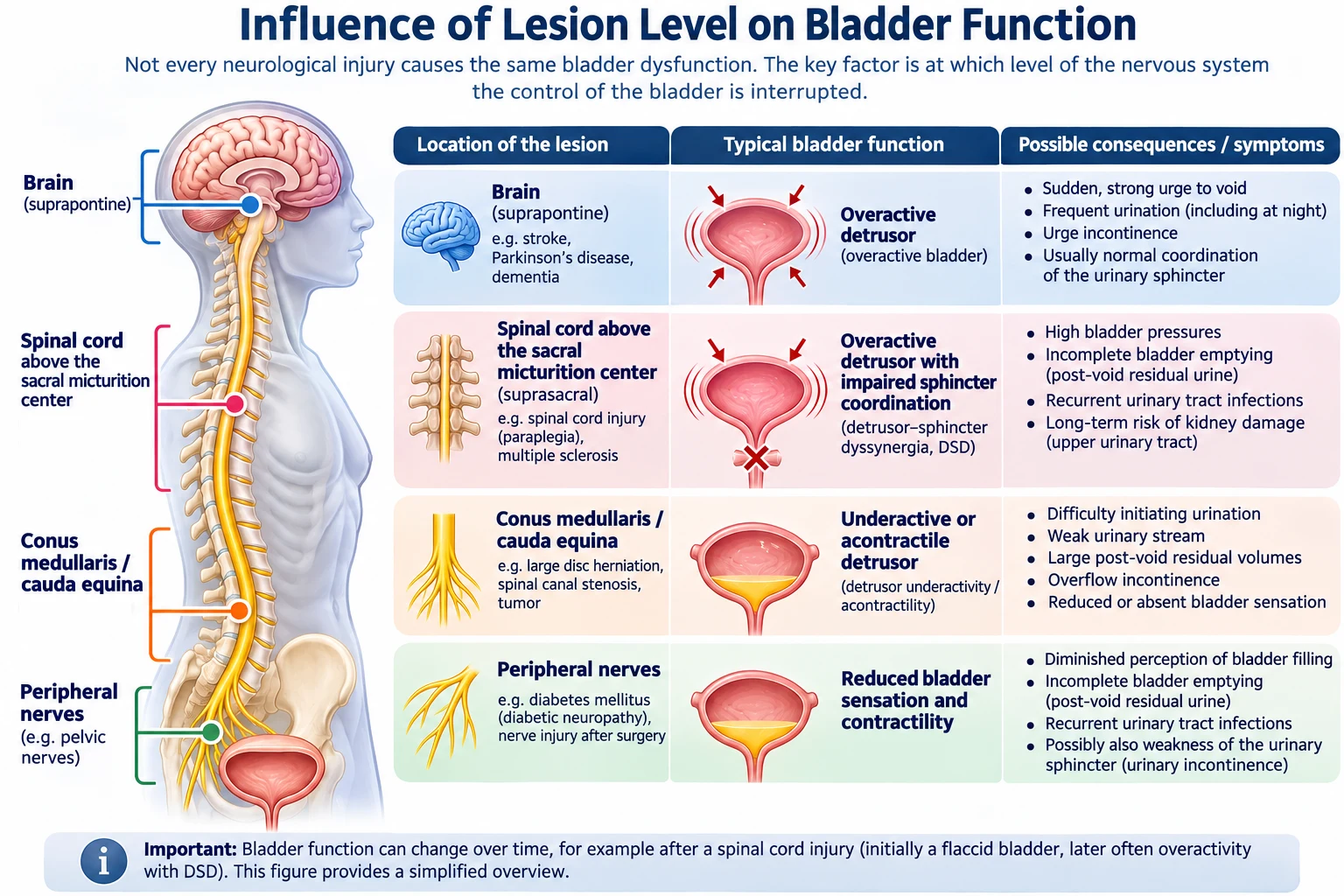
Not every neurological injury produces the same bladder dysfunction. The consequences depend on where communication within the nervous system is interrupted.
Damage to the brain has different effects from an injury to the spinal cord or peripheral nerves.
Understanding the different levels of neurological injury
| Site of neurological injury | Typical bladder dysfunction | Possible consequences |
|---|---|---|
| Brain (suprapontine) | Detrusor overactivity | Urinary urgency, frequency, urgency urinary incontinence |
| Spinal cord above the sacral micturition centre (suprasacral) | Detrusor overactivity, often with detrusor-sphincter dyssynergia | High bladder pressures, residual urine, risk of kidney damage |
| Conus medullaris / cauda equina | Underactive or acontractile detrusor, sometimes sphincter weakness | Urinary retention, overflow incontinence, reduced bladder sensation |
| Peripheral nerves | Reduced bladder sensation and contractility | Incomplete emptying, residual urine, possible urinary tract infections |
Simplified, independently adapted classification based on Queißert and Brücher (2023), Tables 2–5. Actual dysfunction may vary depending on the location, extent and duration of the injury.
1. Brain injuries – the overactive bladder
Certain brain injuries, such as those caused by a stroke, may disrupt the inhibitory signals that normally control the bladder muscle.
As a result, the bladder may contract involuntarily before it is completely full.
Typical symptoms include:
- Sudden, intense urinary urgency
- Frequent urination
- Nocturia
- Urgency urinary incontinence
In purely suprapontine injuries, coordination of the urinary sphincter is often preserved.
Consequently, the risk of upper urinary tract damage is generally lower than with certain spinal cord injuries.
2. Upper spinal cord injuries – when the bladder and sphincter work against each other
Injuries to the spinal cord above the sacral micturition centre can produce particularly complex bladder dysfunction.
The bladder muscle may contract involuntarily while the urinary sphincter fails to relax adequately.
This condition is known as detrusor-sphincter dyssynergia (DSD).
While the bladder attempts to expel urine, the outlet remains partially closed.
This can generate abnormally high pressures inside the bladder.
Over time, these pressures may lead to reduced bladder compliance, urinary retention, recurrent urinary tract infections and kidney damage.
An important risk: Some patients experience little or no bladder sensation because of their neurological injury. Even dangerously high bladder pressures may therefore go unnoticed.
For these patients, protecting long-term kidney function is just as important as managing urinary symptoms.
3. Lower spinal cord injuries – when the bladder loses its strength
Injuries affecting the conus medullaris, cauda equina or sacral nerve pathways often produce a different pattern.
The bladder may lose its ability to contract effectively.
This is referred to as detrusor underactivity or, in the case of complete loss of contraction, detrusor acontractility.
The bladder continues to fill but cannot empty completely.
Typical consequences include:
- Weak urinary stream
- Difficulty emptying the bladder
- Large amounts of residual urine
- Reduced or absent bladder-filling sensation
- Urinary retention or overflow incontinence
Overflow incontinence occurs when urine leaks involuntarily from an overfilled bladder.
These symptoms may resemble those caused by benign prostatic enlargement.
A targeted urodynamic examination can help distinguish true bladder outlet obstruction from weakness of the bladder muscle.
4. Peripheral nerve injuries – when the connection to the bladder is disrupted
Nerves outside the spinal cord can also become damaged.
Such injuries may result from long-standing diabetes, certain pelvic surgical procedures or trauma.
The sensation of bladder filling and the strength of bladder contractions may be impaired.
Consequently, the bladder empties progressively less effectively.
This may result in chronic residual urine and recurrent urinary tract infections.
Damage to certain nerves may also weaken the urinary sphincter, leading to incontinence.
Why bladder function can change after a spinal cord injury
Another important aspect is the progression of neurological injury over time.
Immediately after a severe spinal cord injury, a condition known as spinal shock may occur.
During this phase, the bladder is often flaccid and unable to contract effectively.
However, bladder function may change considerably over the following weeks.
After approximately six to eight weeks, patients with suprasacral spinal cord injuries may develop detrusor overactivity and detrusor-sphincter dyssynergia.
Neurological bladder dysfunction is therefore not necessarily a permanent, unchanging condition. Its characteristics can evolve significantly over time.
This explains why repeated investigations are sometimes necessary in patients with neurological disorders.
Which neurological conditions can affect bladder function?
Multiple sclerosis – when nerve transmission is disrupted
Multiple sclerosis (MS) is a chronic inflammatory disease of the central nervous system.
Damage to nerve pathways can interfere with both urinary storage and bladder emptying.
Many people with MS develop urinary symptoms during the course of their disease.
Common problems include pronounced urinary urgency, frequent urination and urgency urinary incontinence.
Other patients experience incomplete bladder emptying with residual urine.
A characteristic feature of MS is that lesions can occur in different regions of the brain and spinal cord, producing a wide range of bladder dysfunctions.
Even when symptoms are mild, significant abnormalities may be detected during urodynamic testing.
Further neuro-urological evaluation is particularly important in patients with recurrent urinary tract infections, increasing residual urine or an insufficient response to medication.
Parkinson's disease – more than a movement disorder
Parkinson's disease is best known for tremor, muscle stiffness and slow movement.
Less widely recognised is the fact that urinary dysfunction is also common.
Many patients experience urinary urgency and frequent nighttime urination.
As the disease progresses, difficulties with bladder emptying may also develop.
In older men, these symptoms are sometimes prematurely attributed to an enlarged prostate.
However, benign prostatic enlargement and neurological bladder dysfunction may coexist.
Distinguishing between them is especially important when prostate surgery is being considered.
A pressure-flow study performed during urodynamic testing can help differentiate bladder outlet obstruction from impaired bladder muscle contractility.
Diabetes mellitus – when the bladder loses its sensation
Long-standing diabetes mellitus can damage peripheral nerves.
This condition, known as diabetic neuropathy, can also affect the urinary bladder.
In the early stages, patients may experience symptoms resembling an overactive bladder, including increased urinary frequency and urgency.
Later, the sensation of bladder filling may diminish. At the same time, the bladder muscle may gradually lose its ability to contract effectively.
The result can be incomplete emptying with residual urine.
This may increase the risk of urinary tract infections.
For this reason, newly developing urinary symptoms in patients with long-standing diabetes should not automatically be attributed to ageing.
Herniated discs and spinal canal stenosis – when the problem originates in the back
Disorders of the spine can also affect bladder function.
Severe intervertebral disc herniation or narrowing of the spinal canal may impair the nerves responsible for bladder control.
Symptoms may resemble those of an enlarged prostate: a weak urinary stream, difficulty urinating or residual urine.
Accurate diagnosis is essential.
If the underlying problem is neurological, an operation to widen the bladder outlet may not resolve the symptoms.
Important warning: Newly developed difficulty emptying the bladder, together with numbness around the genitals or perineum, new leg weakness or bowel dysfunction, may indicate cauda equina syndrome.
This is a neurological emergency requiring immediate medical assessment.
Stroke, dementia and normal-pressure hydrocephalus
After a stroke, conscious control of urination may be temporarily or permanently impaired.
Urinary urgency and urgency incontinence are common.
Bladder dysfunction can also occur in people with dementia. Cognitive impairment and reduced mobility may further interfere with reaching the toilet in time.
A particular neurological condition is normal-pressure hydrocephalus.
Its characteristic features include gait disturbance, cognitive changes and urinary incontinence.
When this combination is present, neurological or neurosurgical assessment may be necessary.
Spinal cord injury and spina bifida – protecting kidney function
People with spinal cord injuries or spina bifida may develop complex neurogenic bladder dysfunction.
Depending on the level and extent of neurological damage, the bladder may become either overactive or insufficiently contractile.
Particularly concerning are high bladder pressures resulting from impaired coordination between the bladder muscle and urinary sphincter.
Over time, the upper urinary tract and kidneys may be at risk.
Affected patients therefore often require specialised neuro-urological care and regular follow-up.
A particular danger: autonomic dysreflexia
People with spinal cord injuries at or above the T6 neurological level may develop autonomic dysreflexia.
This is a potentially life-threatening abnormal response of the autonomic nervous system.
Possible triggers include an overfilled bladder, a blocked urinary catheter, urinary tract problems or constipation.
A sudden and dangerous rise in blood pressure can occur.
Warning signs may include severe headache, excessive sweating, skin flushing and goosebumps.
Autonomic dysreflexia is a medical emergency and requires immediate treatment.
People with spinal cord injuries at these levels should be informed about possible triggers and warning signs.
How is neurological bladder dysfunction diagnosed?
Neuro-urological assessment involves several investigations.
The process begins with a detailed discussion of urinary symptoms, underlying neurological conditions and previous treatments.
Further investigations are selected according to the individual clinical situation.
- Urine analysis: To detect or exclude urinary tract infections and identify other abnormalities.
- Ultrasound: To examine the kidneys and bladder and measure the amount of urine remaining after voiding.
- Uroflowmetry: To measure urinary flow rate and assess the urinary flow pattern.
- Urodynamic testing: A specialised functional investigation that measures bladder pressure during filling and emptying.
- Video-urodynamics: Combines bladder pressure measurements with imaging of the lower urinary tract. It can be particularly valuable in complex neurogenic bladder disorders.
Why is urodynamic testing so important?
Urodynamics provides an objective assessment of the bladder muscle and urinary sphincter.
It can help answer important questions:
- Does the bladder contract involuntarily?
- Is the bladder able to store urine safely?
- Does the bladder empty at an appropriate pressure?
- Is bladder muscle contractility reduced?
- Do the bladder and sphincter work together correctly?
- Are bladder pressures high enough to endanger the upper urinary tract?
In patients with complex neurological conditions, this information is essential for treatment planning and risk-adapted follow-up.
Which treatments are available?
Treatment depends not only on symptoms but, more importantly, on the underlying functional disorder.
The primary goal is safe urine storage at low pressure and reliable bladder emptying.
Conservative treatment and bladder training
In selected patients, bladder training, adjustments to fluid intake and physiotherapy may help relieve symptoms.
Managing associated constipation and adapting toileting habits can also be beneficial.
Medication
For overactive bladder symptoms, medication may be prescribed to improve urine storage and reduce urgency.
Treatment options include antimuscarinic medications and beta-3 adrenergic receptor agonists.
In older patients and individuals with cognitive impairment, the potential effects of anticholinergic medication on the central nervous system must be carefully considered.
In complex neurogenic bladder disorders, it is also essential to determine whether treatment adequately controls potentially harmful bladder pressures.
Botulinum toxin A – treatment of an overactive bladder muscle
In selected patients with neurogenic detrusor overactivity, botulinum toxin A can be injected directly into the bladder muscle.
This can reduce excessive muscle contractions, improve urinary storage and lower bladder pressures.
The effect generally lasts several months.
Because treatment may also impair bladder emptying, the potential need for intermittent catheterisation must be discussed beforehand.
Clean intermittent self-catheterisation
When the bladder cannot empty adequately, clean intermittent self-catheterisation is an important treatment option.
The bladder is emptied at regular intervals using a thin, single-use catheter.
This method can provide reliable bladder emptying and prevent excessive residual urine.
The most appropriate approach is chosen individually, taking into account hand function, independence, potential risks and personal preferences.
Neuromodulation and surgical treatment
In selected patients, procedures such as sacral neuromodulation may be considered.
In more complex situations, additional surgical procedures may be necessary to improve bladder storage or provide reliable long-term urinary drainage.
These treatments require careful individual assessment and, where appropriate, collaboration with specialised neuro-urological centres.
Why regular follow-up is important
Neurological bladder dysfunction may change as the underlying condition progresses.
Even when symptoms appear well controlled, residual urine, bladder pressure or upper urinary tract function may deteriorate.
Patients at increased risk therefore require regular neuro-urological follow-up.
The frequency and extent of these assessments depend on the neurological condition, the risk of kidney damage and previous investigation results.
The absence of symptoms does not necessarily mean that the bladder is functioning safely.
This principle is particularly important in people with spinal cord injuries and other neurological conditions associated with impaired bladder sensation.
Our conclusion

Bladder control begins in the brain – and bladder health depends on the coordinated function of the entire nervous system.
Urinary symptoms should therefore not always be considered in isolation.
Careful neuro-urological assessment helps distinguish between an overactive bladder, a weak bladder muscle, bladder outlet obstruction and impaired coordination of the urinary sphincter.
At Urologie Zentrum Hergiswil, we emphasise individual and thorough evaluation of urinary storage and bladder emptying disorders.
Our goal is to identify the causes of your symptoms, explain suitable treatment options and help prevent long-term complications.
Because healthy bladder function is not only about quality of life – it is also about protecting your kidneys.
References
- Queißert F, Brücher B. „Neurology meets Urology“: Übersicht urologisch relevanter neurologischer Erkrankungen. Die Urologie. 2023;62(9):965–975. doi:10.1007/s00120-023-02168-4
- European Association of Urology (EAU). EAU Guidelines on Neuro-Urology. EAU Guidelines Office, Arnhem, 2026. uroweb.org/guidelines/neuro-urology
- Sartori AM, Kessler TM, Ecclestone H, et al. European Association of Urology Guidelines on Neuro-urology: Summary of the 2026 Update. European Urology. 2026;90(3):241–253. doi:10.1016/j.eururo.2026.04.012
- Madersbacher H. The various types of neurogenic bladder dysfunction: an update of current therapeutic concepts. Paraplegia. 1990;28(4):217–229. doi:10.1038/sc.1990.28
- Weld KJ, Dmochowski RR. Association of level of injury and bladder behavior in patients with post-traumatic spinal cord injury. Urology. 2000;55(4):490–494. doi:10.1016/S0090-4295(99)00553-1
- Domurath B, Kurze I, Kirschner-Hermanns R, et al. Neurourological assessment in people with multiple sclerosis (MS): a new evaluated algorithm. Multiple Sclerosis and Related Disorders. 2020;44:102248. doi:10.1016/j.msard.2020.102248
Next step
With a GP, HMO or telemedicine insurance model, you usually need a referral.