Cycling is one of the healthiest forms of endurance exercise. It strengthens the cardiovascular system, improves glucose metabolism and places relatively little stress on joint cartilage. Nevertheless, many dedicated road cyclists, gravel riders and mountain bikers experience an unpleasant phenomenon: after long rides, numbness, tingling or pressure-related discomfort may develop in the genital area.
The saddle is often blamed. But is a wider saddle really better? Does a central cut-out reliably protect against vascular and nerve problems? And can an unsuitable saddle impair erectile function in the long term? Research in sports urology provides differentiated answers.
Why the saddle can cause symptoms
During cycling, body weight is distributed across three contact points: the pedals, the handlebars and the saddle. Ideally, the load on the buttocks is carried mainly by the bony sit bones (ischial tuberosities).
Depending on saddle shape and pelvic tilt, however, pressure may shift towards the perineum. There, in the pudendal canal (Alcock's canal), the pudendal nerve runs together with the arteries and veins that supply the genitals. With greater forward tilt of the pelvis, pressure is transferred directly onto the branches of these nerves and vessels.
Prolonged compression has two effects:
- Reduced blood flow: External pressure compresses the small vessels of the perineum. Experimental studies have shown that oxygen levels in penile tissue can fall by more than 70–80% within minutes on certain conventional racing saddles.
- Nerve irritation: Direct compression of the pudendal nerve causes temporary, reversible disturbances of the sensory nerves (neuropraxia).
Typical symptoms
- Numbness or reduced sensation in the glans, scrotum or labia
- Tingling or burning along the perineum
- Activity-related pain in the perineum (pudendal pain)
- Temporary changes in sensation during ejaculation or orgasm
- Temporarily reduced erection firmness immediately after riding
- Painful lumps in the perineum ("biker's nodules")
Temporary numbness is initially a reversible nerve irritation. It does, however, point to pressure peaks that should not be ignored if the load is repeated.
What does scientific research show?
Pressure measurements and nocturnal erections
Pioneering research was carried out by Steven M. Schrader and colleagues at the US National Institute for Occupational Safety and Health (NIOSH):
- In bicycle police officers, conventional saddles with a long, narrow nose produced more than twice the peak perineal pressure (> 20 kPa) of saddles without a pronounced nose (noseless saddles).
- In a six-month study of 68 bicycle police officers, switching to noseless saddles reduced perineal pressure to an average of 11.8 kPa. Nocturnal erections recovered at the same time: their duration rose from an average of 21.2% to 27.1% of sleep time, and participants reported better genital sensation.
Cycling and erectile function
A common concern is that intensive cycling inevitably leads to persistent erectile problems. Large studies put this into perspective:
- The CHEP study (Cycling Health and Epidemics) included 3,932 male athletes (cyclists, runners and swimmers) who completed validated questionnaires on erectile function (IIEF-5) and urinary symptoms (IPSS).
- Overall, cyclists showed no poorer sexual or urinary function than swimmers or runners.
- Within the group of cyclists, however, frequent genital numbness was associated with lower erectile-function scores. Numbness is therefore a warning sign that should be taken seriously, pointing to an unfavourable riding position or an unsuitable saddle.
Systematic reviews
A meta-analysis evaluated 22 studies on reducing perineal pressure during cycling:
- The clearest effect was achieved with saddles without a protruding nose and with recumbent bicycles.
- For saddles with central cut-outs or gel inserts, the effect was more variable, because it depends heavily on pelvic tilt, saddle width and individual anatomy.
Which saddle is right from a urological point of view?
There is no solution that suits everyone, because pelvic anatomy, riding position and requirements differ from person to person. Four factors matter most:
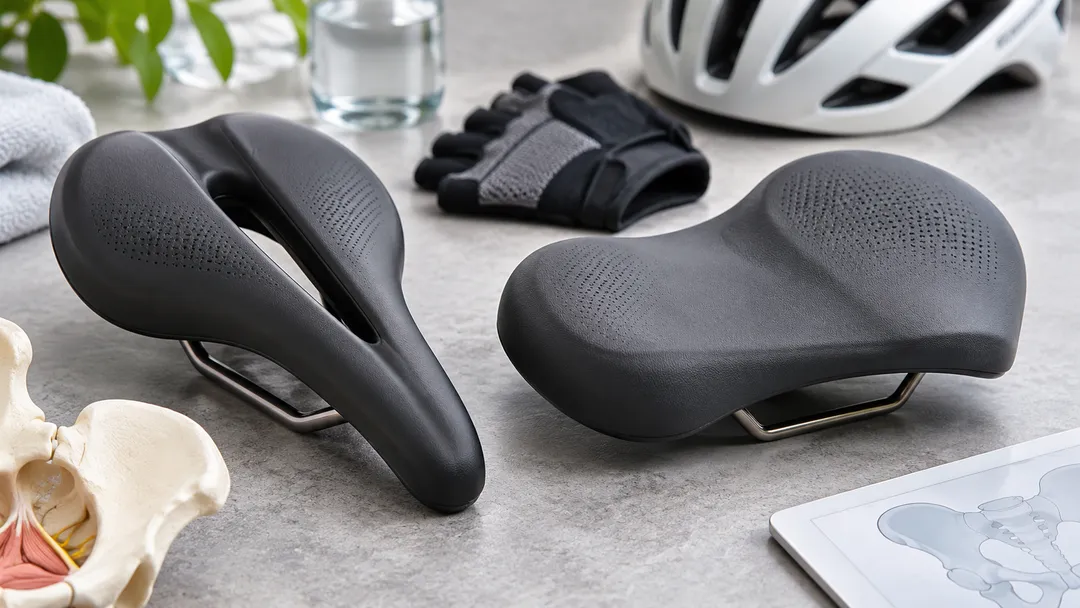
1. The right saddle width
The distance between the two sit bones is the key measurement.
- If the saddle is too narrow, the sit bones are not supported adequately and more body weight is carried by the soft tissues of the perineum.
- If the saddle is too wide, it chafes against the inner thighs, which can lead to compensatory pelvic movements and uneven pressure.
- Ideally, the sit bones are measured and a width allowance is added depending on riding posture (roughly 1–4 cm).
2. Saddles with a cut-out or pressure-relief channel
Many saddles have a central groove or a complete cut-out intended to relieve the midline of the perineum.
- Benefit: If properly designed and fitted, these features can reduce pressure on sensitive structures in the midline, such as the urethra.
- Risk of edge pressure: Removing material in the centre reduces the supporting surface. If the edges are poorly positioned relative to the rider's anatomy, local pressure peaks may arise and aggravate symptoms.
A cut-out therefore does not automatically guarantee better urological protection.
3. Short-nose and noseless saddles
- Noseless saddles remove the forward-projecting nose and shift the load towards the sit bones. They achieve substantial reductions in perineal pressure, but they may alter lateral support and handling, particularly when cornering or riding technical off-road terrain.
- Short-nose saddles, increasingly used in road and gravel cycling, have a shortened front section. They allow a forward-leaning athletic position while relieving the front of the perineum, without giving up the stability of a conventional saddle.
4. Padding: soft or firm?
- Very soft gel padding feels comfortable at first. However, the sit bones sink deeply into the material, which may increase pressure on the adjacent soft tissues.
- Firm, resilient padding or structured three-dimensional materials support the sit bones more stably and can relieve sensitive areas.
What matters is less the thickness of the padding than how the saddle supports the pelvis during real riding.

The best bicycle saddle is not necessarily the softest or most expensive, but the one that provides a stable riding position while minimising pressure on the sensitive perineal area.
Riding position and professional bike fitting
A saddle cannot be assessed in isolation: its effect depends on the entire riding position. A larger drop between saddle and handlebars, with low handlebars, can increase pressure on the perineum. Professional bike fitting coordinates saddle height, fore-aft saddle position (setback), saddle tilt (a slight forward tilt of about 1–2 degrees is sometimes recommended, although individual needs differ), handlebar height and stem length. The aim is an efficient riding position without excessive pressure on sensitive structures.
Six recommendations for prevention
- Take numbness seriously: Tingling or numbness in the genital area is not an unavoidable part of cycling. It may indicate excessive pressure on the sensory nerves.
- Have your sit-bone width measured: The saddle width should be based on a measurement of the sit bones.
- Watch for edge pressure: With a cut-out saddle, make sure the edges do not cut into the soft tissues of the perineum.
- Relieve pressure regularly: Standing on the pedals for about 15–30 seconds every 10–15 minutes interrupts the pressure on the perineum. These times are practical guidelines, not clinically validated thresholds.
- Choose cycling shorts carefully: A well-fitting, elastic and wrinkle-free chamois pad reduces friction and shear forces. Excessively thick padding is not always more comfortable.
- Use professional bike fitting: If symptoms persist, have saddle position, handlebar height and overall riding posture reassessed.
When is a urological assessment advisable?
We recommend an examination if
- numbness or altered sensation persists for several hours after getting off the bike,
- perineal pain continues or keeps recurring (suspected pudendal neuralgia or chronic pelvic pain syndrome),
- new erectile difficulties develop,
- urinary symptoms arise, such as painful urination, a weak stream or increased urinary frequency,
- painful lumps or hardened areas appear in the perineum or buttocks.
Assessment begins with a detailed medical history and a targeted physical examination. Depending on the findings, further investigations may include ultrasound, assessment of penile blood flow (duplex ultrasonography) or a neurological opinion. Not every patient needs imaging; investigations are chosen according to symptoms and findings. Dr. Hoffmann is happy to advise cyclists on urological questions.
Conclusion
Saddle design and riding position can substantially influence the pressure on sensitive nerves and blood vessels of the perineum. A well-chosen saddle, a balanced riding position and awareness of early warning signs help to reduce urological discomfort when cycling. Current evidence does not establish that cycling generally causes permanent erectile dysfunction. Nevertheless, recurrent or persistent genital numbness should be investigated rather than ignored.
Scientific references
- Schrader SM et al. Health Hazard Evaluation Report: Police Officers' Bicycle Saddles. National Institute for Occupational Safety and Health (NIOSH); 2002.
- Schrader SM et al. Cutting Off the Nose to Save the Penis. The Journal of Sexual Medicine. 2008;5(8):1932–1940.
- Awad MA et al. Cycling, and Male Sexual and Urinary Function: Results from a Large, Multinational, Cross-Sectional Study. The Journal of Urology. 2018;199(3):798–804.
- Sommer F et al. Impotence and Bicycling: A Seldom Discussed Problem. Deutsche Medizinische Wochenschrift. 2001;126(34–35):939–943.
- Schwarzer U et al. Bicycle Riding and Erectile Dysfunction: An Increase in Interest. European Urology. 2002;42(5):439–443.
- Litwinowicz K, Choroszy M, Wróbel A. Strategies for Reducing the Impact of Cycling on the Perineum in Healthy Males: Systematic Review and Meta-analysis. Sports Medicine. 2021;51:275–287.