Prostate Cancer Screening: New US Guidelines Recommend Regular PSA Testing
12 November 2026
An important shift in prostate cancer screening: the American Cancer Society now explicitly recommends regular PSA testing for men aged 50 and older. The updated recommendations reflect new scientific evidence and advances in diagnostic techniques that can help reduce unnecessary biopsies and treatments.

Key Points
- The American Cancer Society recommends PSA testing every two years for men aged 50 to 69 at average risk.
- With a strong family history, and for Black men, screening is recommended from age 45.
- An elevated PSA level is not proof of cancer. Modern MRI helps avoid unnecessary biopsies.
- Not every prostate cancer needs immediate treatment: active surveillance is an important option.
- In Switzerland, an individually discussed, risk-adapted approach to screening remains the focus.
A New Approach to Prostate Cancer Screening
Prostate cancer screening has been a subject of debate for many years. On the one hand, a PSA blood test can help detect prostate cancer at an early stage, before symptoms develop or the disease spreads. On the other hand, screening may also identify slow-growing cancers that would never have caused problems during a man's lifetime.
On 12 November 2026, the American Cancer Society (ACS), one of the leading organisations in cancer prevention, substantially updated its recommendations.
The most important change is that men aged 50 to 69 with an average risk of prostate cancer are now explicitly recommended to undergo PSA testing every two years.
Previously, the emphasis was primarily on making an individual decision following a discussion with a physician. With its updated guidelines, the ACS now takes a more proactive position in favour of regular screening.
Discussing the benefits and potential risks of screening remains an essential part of medical care.
At What Age Should Men Start PSA Testing?
The new American recommendations distinguish between age groups and individual risk factors.
| Group | New ACS Recommendation |
|---|---|
| Average-risk men aged 50–69 | PSA testing every two years |
| Men with a strong family history | Annual screening from age 45 |
| Black men | Annual screening from age 45 |
| Men with one first-degree relative diagnosed at age 65 or older | Screening every two years from age 45 |
| Men aged 70–74 | Individualised decision |
| Men aged 75 and older | Generally not recommended, with exceptions for men in excellent health |
| Men aged 80 and older | No screening recommended |
European guidelines also support a risk-adapted approach to prostate cancer screening. Men carrying a pathogenic BRCA2 mutation may benefit from starting PSA-based screening as early as age 40.
Why Is Regular PSA Screening Now More Strongly Recommended?
One of the main scientific foundations for this change is the European Randomized Study of Screening for Prostate Cancer (ERSPC).
This large randomised study followed more than 160,000 men over an extended period.
After a median follow-up of 23 years, the findings showed:
- A 13% relative reduction in prostate cancer-specific mortality among men invited for screening.
- An absolute risk reduction of 0.22 percentage points.
- Approximately one prostate cancer death prevented for every 456 men invited for screening.
These results confirm that PSA-based screening can save lives. At the same time, they demonstrate that the absolute benefit for each individual is relatively modest and needs to be balanced against potential harms.
What You Should Know
Four questions we are asked most often in the practice. Click to expand.
An Elevated PSA Level Does Not Automatically Mean Cancer
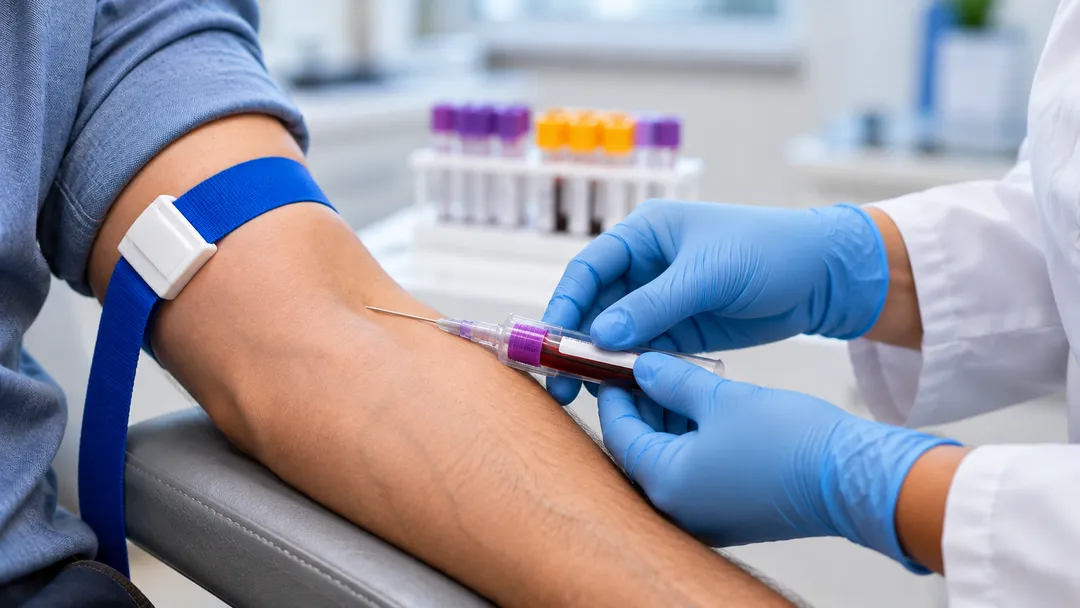
Prostate-specific antigen (PSA) is a protein produced by the prostate that can be measured through a blood test.
However, an elevated PSA level does not necessarily indicate prostate cancer.
Benign prostate enlargement, inflammation and other temporary factors can also cause PSA levels to rise.
For this reason, the updated American guidelines recommend repeating the PSA test before proceeding with further investigations.
For men aged 45 to 69, a PSA level of 3.0 ng/mL or higher is considered a threshold for repeat testing. The test should initially be repeated within two weeks to three months.
What matters is not simply the PSA value itself, but the assessment of each man's individual risk.
Relevant factors include age, changes in PSA over time, prostate volume, PSA density and family history.
How Modern MRI Has Changed Prostate Cancer Diagnosis
One of the most important developments in recent years has been the increasing use of multiparametric magnetic resonance imaging (mpMRI) of the prostate.
In the past, an elevated PSA level was more likely to lead directly to a prostate biopsy.
Today, an MRI scan can be performed before deciding whether a biopsy is necessary. This examination helps identify suspicious areas within the prostate and provides a more accurate assessment of the likelihood of clinically significant prostate cancer.
If a biopsy is required, suspicious areas can be sampled precisely using techniques such as MRI/ultrasound fusion-guided biopsy.
Combining PSA-based risk assessment with modern imaging helps detect clinically significant cancers while reducing unnecessary biopsies.
However, a normal MRI scan cannot completely exclude prostate cancer. The decision to perform a biopsy must therefore consider all available clinical findings.
Not Every Prostate Cancer Requires Immediate Treatment
Another important advance is the growing use of active surveillance.
Many prostate cancers detected at an early stage grow slowly and have a low risk of causing symptoms or spreading in the near future.
For appropriately selected men with low-risk prostate cancer, immediate surgery or radiotherapy is not always necessary.
Instead, the cancer can be carefully monitored through regular PSA tests, MRI examinations and, when indicated, repeat biopsies.
Definitive treatment is considered if there is evidence that the cancer is progressing.
This approach can help avoid or delay potential treatment-related side effects, particularly urinary incontinence and erectile dysfunction.
What Do the New Guidelines Mean for Men in Switzerland?
The updated recommendations from the American Cancer Society are intended for the United States. They do not mean that a nationwide prostate cancer screening programme will automatically be introduced in Switzerland.
In Switzerland, prostate cancer screening continues to focus on an individualised, risk-adapted approach based on an informed discussion between the patient and his physician.
The 2026 guidelines of the European Association of Urology (EAU) also support offering PSA-based screening to well-informed men from approximately 50 years of age. Earlier screening may be appropriate for men at increased risk.
Decisions should take into account life expectancy, overall health, family history and personal preferences.
The key development is that an elevated PSA level no longer automatically leads to a biopsy or, indeed, treatment.
Our Conclusion: Detect Cancer Earlier, Investigate More Precisely, Avoid Unnecessary Treatment
The updated American guidelines represent an important development in prostate cancer screening.
Long-term scientific evidence shows that regular PSA testing can reduce the risk of dying from prostate cancer.
At the same time, modern diagnostic methods, including multiparametric MRI and MRI/ultrasound fusion-guided biopsy, allow for a more precise and individualised assessment.
Our goal is to detect clinically significant prostate cancer early while avoiding unnecessary investigations and treatments whenever possible.
A personal urological consultation can help determine the most appropriate starting age and screening intervals for each individual. More on our prostate screening page.
Scientific References
- American Cancer Society. Updated Prostate Cancer Screening Guideline, 12 November 2026.
- European Randomized Study of Screening for Prostate Cancer (ERSPC). European Study of Prostate Cancer Screening – 23-Year Follow-up. New England Journal of Medicine, 2025.
- European Association of Urology. EAU Guidelines on Prostate Cancer, 2026.